
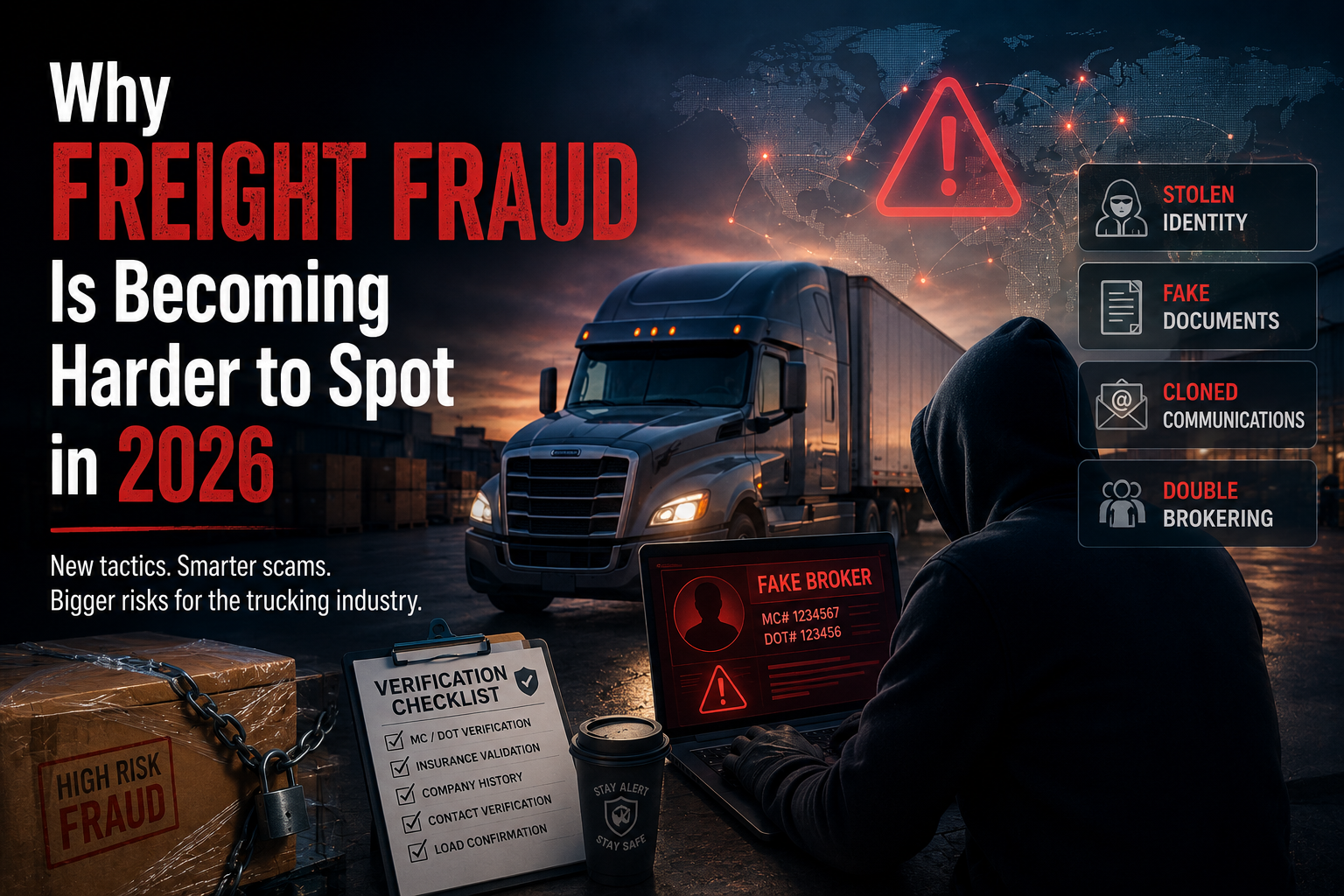
Why Freight Fraud Is Becoming Harder to Spot in 2026
For decades, freight fraud in the trucking industry followed a relatively predictable pattern. Stolen cargo, forged paperwork, and fake identities were concerns, but most scams could be identified through basic verification processes and industry experience.
Today, the landscape has changed dramatically.
As the trucking industry becomes increasingly digital, fraudsters are becoming more sophisticated. They are no longer relying solely on fake documents or stolen loads. Instead, they are leveraging technology, exploiting digital platforms, impersonating legitimate businesses, and finding new ways to infiltrate freight networks.
For carriers, brokers, dispatchers, and owner-operators, freight fraud has evolved from an occasional inconvenience into a growing operational threat.
The challenge is no longer simply preventing fraud. The challenge is identifying it before it happens.
In 2026, freight fraud is becoming harder to spot, more difficult to prevent, and potentially more damaging than ever before.
The Digital Transformation of Freight
The trucking industry has embraced technology at an unprecedented pace.
Digital load boards, transportation management systems, freight marketplaces, GPS tracking, automated documentation, and AI-powered logistics tools have improved efficiency across the supply chain.
These advancements have made it easier for legitimate businesses to connect and move freight.
Unfortunately, they have also created new opportunities for fraudsters.
Criminals no longer need physical access to cargo yards or warehouses to exploit vulnerabilities. Many modern scams begin online, where fake identities and fraudulent business profiles can be created with relative ease.
As freight operations become more connected, fraud schemes become more sophisticated.
The Rise of Identity Theft in Trucking
One of the fastest-growing forms of freight fraud involves identity theft.
Fraudsters increasingly impersonate legitimate carriers, brokers, and dispatching companies.
In many cases, scammers:
- Create fake email addresses
- Clone company websites
- Use stolen MC numbers
- Copy DOT registration information
- Mimic legitimate business branding
To an unsuspecting broker or shipper, everything appears legitimate.
The fraudulent company may have a professional website, valid-looking documentation, and convincing communication.
By the time the deception is discovered, the cargo may already be gone.
The problem is that modern fraud no longer looks obviously suspicious.
In many cases, it looks exactly like a legitimate business.
Double Brokering Continues to Evolve
Double brokering remains one of the most significant fraud challenges in the industry.
This occurs when a broker secures freight and then illegally re-brokers the load without the shipper’s knowledge or approval.
The load often passes through multiple parties before reaching the actual carrier.
As a result, problems frequently arise involving:
- Delayed payments
- Lost accountability
- Insurance disputes
- Cargo visibility issues
- Delivery complications
What makes double brokering particularly difficult to detect is the complexity of modern freight networks.
The larger and faster the network becomes, the easier it is for fraudulent transactions to hide within legitimate business activity.
AI Is Creating New Fraud Risks
Artificial Intelligence is helping trucking companies improve efficiency, but it is also creating new opportunities for cybercriminals.
Fraudsters now have access to tools that can generate:
- Professional business communications
- Realistic documents
- Fake company profiles
- Convincing customer interactions
Some scams that once contained obvious spelling mistakes and formatting errors now appear highly professional.
As AI-generated content becomes more sophisticated, traditional warning signs become less reliable.
This makes verification processes more important than ever.
Fraudsters Are Exploiting Urgency
Many freight scams rely on creating urgency.
A fraudster may claim:
- A truck is immediately available
- A shipment must move quickly
- Documentation must be processed urgently
- A load requires immediate reassignment
When businesses operate under time pressure, verification steps are often skipped.
This creates opportunities for fraudulent actors to enter the supply chain.
The trucking industry operates on tight schedules and fast decision-making, making urgency one of the most effective tools in a fraudster’s arsenal.
Why Smaller Carriers Are Often More Vulnerable
Large logistics companies often have dedicated compliance teams, security procedures, and fraud prevention protocols.
Many owner-operators and smaller carriers do not.
Independent operators frequently manage multiple responsibilities simultaneously, including:
- Dispatching
- Operations
- Compliance
- Customer communication
- Documentation
With limited resources, verifying every transaction can be challenging.
Fraudsters understand this reality and often target businesses that may have fewer verification processes in place.
This makes vigilance especially important for small fleets and owner-operators.
The Financial Impact of Freight Fraud
Freight fraud extends far beyond the value of stolen cargo.
Its consequences often include:
- Lost revenue
- Unpaid invoices
- Insurance complications
- Operational disruptions
- Customer dissatisfaction
- Damaged business relationships
A single fraudulent transaction can create weeks or even months of administrative and financial challenges.
For smaller carriers, the impact can be particularly severe.
Beyond immediate financial losses, fraud can damage trust between brokers, carriers, and shippers.
Trust is one of the most valuable assets in freight transportation, and fraud undermines it.
Why Traditional Verification Methods Are No Longer Enough
In the past, many businesses relied on simple checks to verify legitimacy.
These included:
- Reviewing MC numbers
- Checking insurance certificates
- Confirming contact information
While these steps remain important, they are no longer sufficient on their own.
Modern fraudsters often have access to stolen or duplicated information that appears legitimate.
Businesses must now take a more comprehensive approach to verification.
This includes:
- Verifying contact information through official sources
- Confirming company details independently
- Monitoring unusual communication patterns
- Reviewing business histories carefully
- Using trusted industry platforms
The goal is not simply to verify documentation but to verify the people behind it.
Building a Fraud-Resistant Operation
No system can eliminate fraud.
However, companies can significantly reduce risk by creating stronger operational safeguards.
Successful fraud prevention strategies often include:
Strong Verification Procedures
Every new carrier, broker, or business partner should undergo thorough verification.
Employee Training
Staff should understand common fraud tactics and warning signs.
Consistent Communication Protocols
Unexpected requests, unusual payment instructions, or sudden contact changes should trigger additional verification.
Technology Monitoring
Fraud prevention software and security tools can help identify suspicious activities before they become major problems.
Industry Awareness
Staying informed about emerging fraud trends helps businesses adapt to evolving threats.
The Human Element Remains Critical
Despite advances in technology, fraud prevention still relies heavily on human judgment.
Experienced dispatchers, brokers, and operations professionals often recognize inconsistencies that automated systems may miss.
Questions such as:
- Does this request seem unusual?
- Is this communication consistent with past interactions?
- Does this business behavior make sense?
Often leads to the discovery of potential fraud.
Technology can assist verification, but human experience remains one of the strongest defenses against deception.
How Truckings Pro Prioritizes Secure Freight Operations
At Truckings Pro, we understand that trust is essential in freight management.
As fraud tactics continue to evolve, carriers and dispatch teams must remain vigilant.
Our approach emphasizes:
- Careful verification procedures
- Strong communication practices
- Reliable broker relationships
- Operational transparency
- Industry best practices
By prioritizing security and due diligence, we help reduce risks while supporting efficient freight operations.
Final Thoughts
Freight fraud is not a new problem, but it is becoming a more sophisticated one.
As technology transforms the trucking industry, fraudsters are adapting their methods to exploit digital systems, impersonate legitimate businesses, and bypass traditional verification processes.
The challenge facing carriers and logistics professionals in 2026 is not simply recognizing fraud after it occurs. It is identifying warning signs early enough to prevent losses before they happen.
Companies that invest in verification, training, technology, and industry awareness will be better positioned to protect themselves in an increasingly complex freight environment.
In today’s trucking industry, vigilance is no longer optional. It is an essential part of doing business.