Why Real-Time Visibility Is Becoming a Competitive Advantage
The trucking industry has always relied on one essential factor: information. Knowing where a truck is, when it will arrive, whether a shipment is delayed, or how traffic will affect delivery schedules has always influenced operational decisions. The difference today is that businesses no longer have to wait hours, or even minutes, for that information.
Real-time visibility has transformed how freight moves across the supply chain.
What was once considered a premium feature has quickly become an industry expectation. Shippers want instant shipment updates, brokers expect accurate ETAs, fleet owners need operational insights, and customers demand complete transparency throughout the delivery process.
For trucking companies, real-time visibility is no longer simply a technology upgrade. It has become a competitive advantage that improves efficiency, strengthens customer relationships, reduces operational disruptions, and supports better business decisions.
As the trucking industry becomes increasingly data-driven, companies that invest in visibility are positioning themselves ahead of competitors still relying on outdated communication methods.
What Is Real-Time Visibility in Trucking?
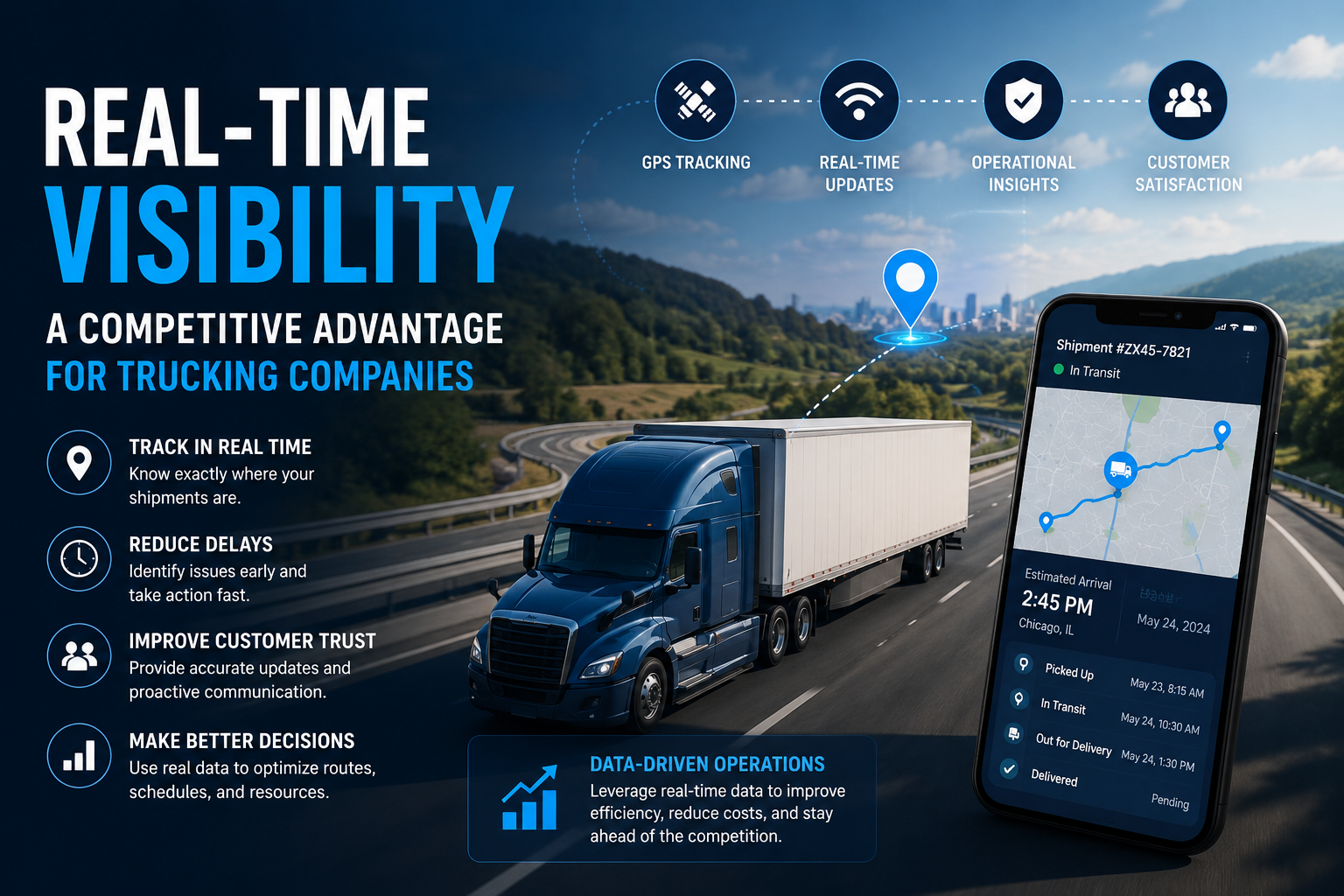
Real-time visibility refers to the ability to monitor trucks, shipments, and freight operations in real time.
Rather than relying on periodic phone calls or manual updates, modern visibility systems provide continuous access to operational data through GPS tracking, telematics, transportation management systems (TMS), electronic logging devices (ELDs), and digital freight platforms.
This allows carriers, brokers, and shippers to monitor:
- Vehicle location
- Estimated arrival times (ETAs)
- Route progress
- Traffic delays
- Delivery status
- Driver availability
- Shipment milestones
Instead of reacting to problems after they occur, businesses can identify issues early and make informed decisions before delays impact customers.
Customer Expectations Have Changed
Today’s logistics customers expect transparency.
Whether shipping consumer goods, industrial equipment, or retail products, businesses want to know exactly where their freight is at any given moment.
Years ago, a customer might have accepted occasional status updates over the phone.
Today, expectations are very different.
Customers now expect:
- Accurate delivery estimates
- Instant shipment updates
- Proactive communication
- Faster responses to delays
- Complete shipment visibility
Companies that fail to provide this level of transparency often appear less reliable, even if deliveries are completed successfully.
Real-time visibility has become an important part of customer service rather than simply an operational tool.
Better Decisions Through Better Data
One of the greatest advantages of real-time visibility is improved decision-making.
Fleet managers and dispatchers constantly make decisions that affect profitability and customer satisfaction.
Without accurate information, those decisions are often based on assumptions.
Real-time operational data allows teams to make informed decisions regarding:
- Route adjustments
- Driver scheduling
- Load assignments
- Delivery priorities
- Equipment utilization
Instead of waiting for problems to develop, businesses can respond immediately when conditions change.
This ability to make faster, data-driven decisions creates a measurable competitive advantage.
Improving Dispatch Efficiency
Dispatchers are responsible for coordinating multiple moving parts simultaneously.
They manage drivers, schedules, freight availability, appointments, and customer communication, all while responding to changing road conditions.
Real-time visibility significantly improves dispatch efficiency by providing immediate access to operational information.
Dispatchers can:
- Monitor truck locations
- Track delivery progress
- Identify delays
- Coordinate reloads more efficiently
- Adjust schedules when necessary
Rather than spending valuable time calling drivers for updates, dispatch teams can focus on solving problems and optimizing operations.
This allows dispatchers to become more proactive instead of reactive.
Reducing Delays Before They Become Problems
Unexpected delays are inevitable in trucking.
Traffic congestion, weather conditions, construction zones, mechanical issues, and detention time can all affect delivery schedules.
The difference lies in how quickly those issues are identified.
Real-time visibility allows carriers to recognize disruptions as they happen.
This enables dispatchers to:
- Notify customers immediately
- Update delivery estimates
- Reroute trucks when possible
- Coordinate alternative solutions
Early communication often prevents small operational issues from becoming major customer service problems.
Building Stronger Customer Relationships
Trust is one of the most valuable assets in the transportation industry.
Customers appreciate honesty and proactive communication, especially when unexpected situations occur.
Real-time visibility allows trucking companies to provide accurate information instead of estimates based on assumptions.
When customers receive timely updates, they gain confidence in the carrier’s ability to manage shipments professionally.
This transparency strengthens long-term relationships and encourages repeat business.
In many cases, reliable communication becomes just as important as on-time delivery.
Supporting Better Fleet Utilization
Visibility is not only about tracking trucks.
It also helps companies understand how effectively their assets are being used.
Fleet managers can analyze:
- Idle time
- Driver productivity
- Equipment availability
- Route performance
- Delivery efficiency
These insights help identify operational inefficiencies that may otherwise remain unnoticed.
Improving fleet utilization often leads to better scheduling, reduced downtime, and more consistent freight movement.
Over time, these operational improvements contribute to stronger business performance.
Real-Time Visibility Enhances Safety
Modern visibility systems also support safer fleet operations.
Fleet managers can monitor driving behavior, identify unexpected route deviations, and respond more quickly during emergencies.
Visibility technologies often provide information regarding:
- Speed patterns
- Route compliance
- Vehicle status
- Driver activity
- Emergency alerts
This information helps businesses improve safety policies while protecting both drivers and valuable cargo.
Safety improvements also contribute to stronger customer confidence and operational reliability.
Technology Is Changing the Competitive Landscape
The trucking industry has become increasingly competitive.
Many carriers operate similar equipment, serve comparable markets, and offer competitive pricing.
Technology has become one of the primary differentiators.
Companies that leverage real-time visibility can provide faster communication, better planning, improved operational efficiency, and a superior customer experience.
Meanwhile, businesses relying on manual processes often struggle to match these expectations.
Technology alone does not create success, but companies that ignore technological advancements may find themselves at a competitive disadvantage.
Real-Time Visibility Supports Smarter Business Growth
Growth requires more than acquiring additional trucks.
It requires understanding how existing resources perform.
Visibility data allows business owners to evaluate operational performance by identifying:
- High-performing freight lanes
- Delivery trends
- Equipment utilization rates
- Customer service performance
- Scheduling efficiency
Rather than making decisions based on assumptions, fleet owners can use measurable data to guide expansion strategies.
This leads to more sustainable and profitable growth.
Human Expertise Still Matters
While technology provides valuable information, it does not replace experienced professionals.
Real-time visibility tells businesses what is happening.
Experienced dispatchers determine what should happen next.
Human expertise remains essential for:
- Negotiating freight
- Solving unexpected operational challenges
- Communicating with brokers
- Supporting drivers
- Making strategic decisions
The most successful trucking companies combine advanced technology with knowledgeable dispatch professionals who know how to interpret information and respond effectively.
How Truckings Pro Uses Real-Time Visibility to Improve Operations
At Truckings Pro, we believe technology should enhance, not replace, professional dispatching.
Our team combines real-time visibility tools with industry expertise to help carriers make informed operational decisions.
By monitoring freight movement, improving communication, coordinating efficient routes, and responding quickly to unexpected situations, we help owner-operators and fleet owners maintain greater operational control.
Our goal is to ensure every shipment moves as efficiently as possible while providing the transparency that today’s customers expect.
Final Thoughts
The trucking industry is entering a new era where information is just as valuable as equipment.
Real-time visibility allows businesses to move beyond reactive operations and adopt a more proactive approach to freight management. From improving dispatch efficiency and customer communication to reducing delays and optimizing fleet utilization, visibility has become an essential part of modern trucking operations.
As customer expectations continue to evolve, companies that embrace real-time visibility will be better positioned to build trust, improve operational performance, and remain competitive in an increasingly digital industry.
In today’s freight market, success is no longer determined solely by how quickly a truck can move. It is also determined by how effectively businesses can see, manage, and respond to every mile of the journey.