
Why Smart Fleets Are Using Predictive Maintenance to Stay on the Road
The trucking industry has always depended on one critical factor: keeping trucks on the road. Every mile driven represents productivity, customer satisfaction, and business growth. However, every unexpected breakdown tells a different story. A truck sitting in a repair shop instead of hauling freight can disrupt schedules, delay deliveries, and damage customer relationships.
For decades, fleet maintenance followed a reactive approach. Trucks were repaired only after something failed or serviced according to fixed maintenance schedules, regardless of their actual condition. While this strategy worked in the past, modern fleet operations demand something more intelligent.
Today, leading transportation companies are embracing predictive maintenance. This data-driven approach uses vehicle diagnostics, sensors, telematics, and artificial intelligence (AI) to detect potential mechanical issues before they become costly breakdowns.
Predictive maintenance is no longer reserved for large enterprise fleets. As technology becomes more accessible and affordable, fleets of all sizes are using predictive insights to improve reliability, reduce downtime, and operate more efficiently.
In an industry where every hour matters, preventing breakdowns has become just as important as finding the next load.
The Evolution of Fleet Maintenance
Fleet maintenance has changed significantly over the years.
Traditionally, trucking companies relied on reactive maintenance, repairing vehicles only after a component failed. While this approach minimized short-term maintenance costs, it often resulted in unexpected breakdowns, emergency repairs, missed deliveries, and expensive roadside assistance.
To improve reliability, many fleets adopted preventive maintenance, servicing vehicles at scheduled mileage or time intervals. Although preventive maintenance reduced failures, it still relied on estimated service schedules rather than the actual condition of vehicle components.
Predictive maintenance represents the next stage of this evolution.
Instead of guessing when maintenance should occur, predictive systems continuously analyze real-time vehicle data to determine when components are likely to fail. This allows maintenance teams to address issues before they disrupt operations.
Rather than reacting to problems, smart fleets prevent them.
What Is Predictive Maintenance?
Predictive maintenance is a maintenance strategy that uses connected technology to monitor vehicle health while they are operating.
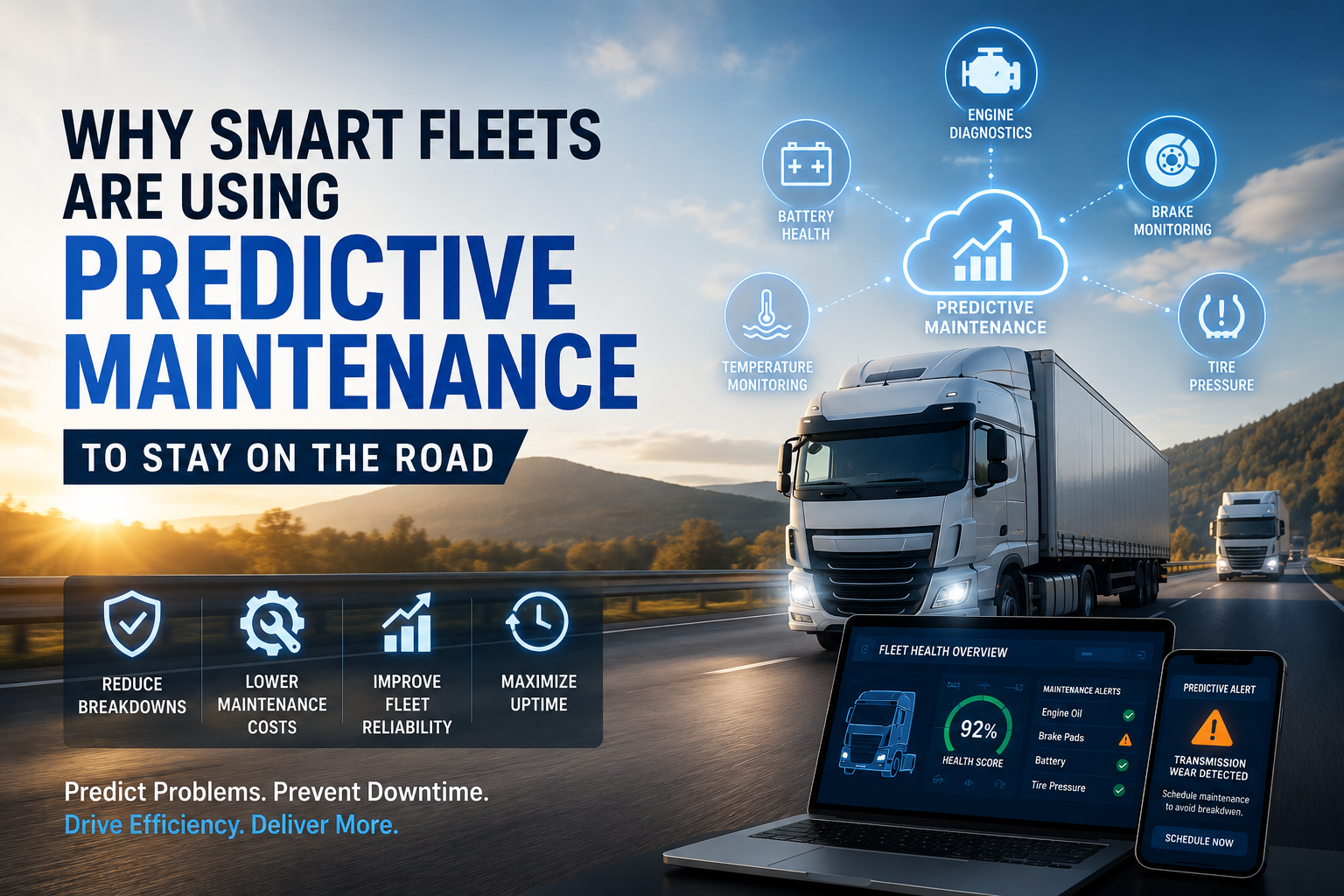
Modern trucks generate thousands of data points every day through onboard sensors and electronic control systems. These systems monitor everything from engine temperature and oil pressure to battery performance, brake wear, transmission health, and tire pressure.
Using telematics, IoT (Internet of Things) devices, and AI-powered analytics, fleet managers receive alerts when vehicle performance begins to change.
For example, instead of waiting for a battery to fail unexpectedly, predictive systems may detect a decline in voltage levels weeks in advance. Maintenance can then be scheduled during planned downtime rather than during an emergency on the highway.
This proactive approach helps fleets reduce unexpected repairs while improving operational reliability.
Why Smart Fleets Are Making the Shift
Fleet operators today face increasing pressure to improve efficiency while meeting customer expectations for reliable deliveries and real-time visibility.
Unexpected vehicle failures make achieving these goals much more difficult.
Predictive maintenance helps fleets stay ahead of problems by transforming maintenance from a reactive activity into a strategic advantage.
Instead of asking, “What broke?”, smart fleets ask, “What could break next, and how do we prevent it?”
This shift enables better planning, stronger operational performance, and greater confidence across the business.
Reducing Unexpected Breakdowns
One of the biggest advantages of predictive maintenance is its ability to reduce unplanned vehicle failures.
Mechanical problems rarely appear without warning. In most cases, vehicles exhibit subtle changes in performance before major failures occur.
Predictive systems monitor these changes continuously and notify fleet managers when maintenance is needed.
Components commonly monitored include:
- Engine performance
- Transmission health
- Brake systems
- Tire pressure
- Battery condition
- Cooling systems
- Fuel system performance
By addressing these issues early, fleets avoid costly roadside breakdowns and minimize disruptions to delivery schedules.
Improving Fleet Reliability
Reliability is one of the most valuable assets in the transportation industry.
Customers expect shipments to arrive safely and on time. Brokers prefer carriers with dependable service records. Drivers also benefit from operating equipment they can trust.
Predictive maintenance supports reliability by reducing mechanical failures that lead to delays and cancelled deliveries.
A truck that consistently performs as expected becomes a more valuable business asset than one that frequently requires emergency repairs.
Over time, improved reliability strengthens customer relationships and enhances a carrier’s reputation.
Better Maintenance Planning
Traditional maintenance often interrupts operations unexpectedly.
Predictive maintenance allows fleets to schedule repairs at convenient times.
Instead of removing trucks from service during busy periods, maintenance managers can coordinate repairs around delivery schedules, driver availability, and planned downtime.
This creates several operational benefits:
- Improved workshop scheduling
- Better parts inventory management
- Reduced emergency repairs
- Increased vehicle availability
- More efficient maintenance teams
Planning maintenance strategically minimizes disruption while maximizing productivity.
Supporting Driver Safety
Vehicle safety is closely linked to maintenance quality.
Issues such as worn brakes, underinflated tires, battery failures, and cooling system problems can increase operational risks if left undetected.
Predictive maintenance helps identify these problems before they become safety concerns.
Drivers gain greater confidence knowing that vehicles are continuously monitored for potential mechanical issues.
Safer equipment not only protects drivers but also helps reduce accident risks, improve compliance, and strengthen customer confidence.
How Technology Makes Predictive Maintenance Possible
Modern predictive maintenance relies on several advanced technologies working together.
Telematics
Telematics systems collect real-time information about vehicle performance and transmit it to fleet management platforms.
IoT Sensors
Connected sensors monitor engine performance, tire pressure, battery health, braking systems, and other critical components.
Artificial Intelligence
AI analyzes large volumes of operational data to identify patterns that may indicate future mechanical failures.
Cloud-Based Fleet Management Platforms
Cloud software allows maintenance teams to access vehicle health reports, maintenance schedules, diagnostic alerts, and performance dashboards from virtually anywhere.
Together, these technologies provide fleets with continuous visibility into vehicle health and operational performance.
The Business Benefits Beyond Maintenance
Predictive maintenance offers benefits that extend beyond vehicle repairs.
When fleets experience fewer unexpected breakdowns, the entire business becomes more efficient.
Operational improvements often include:
- More reliable delivery schedules
- Improved customer satisfaction
- Better fleet utilization
- Increased driver confidence
- Reduced operational disruptions
- Stronger long-term planning
Rather than viewing maintenance as simply an expense, many companies now recognize it as an investment in operational stability.
Challenges of Implementing Predictive Maintenance
Like any technology, predictive maintenance requires planning and investment.
Fleet owners may need to consider:
- Installing telematics systems
- Training maintenance personnel
- Integrating software platforms
- Managing vehicle data
- Updating maintenance workflows
While implementation requires effort, many fleets find that the long-term operational improvements outweigh the initial investment.
The key is selecting solutions that align with fleet size, operational goals, and business needs.
The Future of Fleet Maintenance
As AI, machine learning, and connected vehicle technologies continue to evolve, predictive maintenance will become even more intelligent.
Future systems may be able to:
- Predict failures with greater accuracy
- Schedule maintenance automatically
- Order replacement parts in advance
- Coordinate workshop appointments
- Optimize maintenance based on driver behavior and operating conditions
Instead of reacting to mechanical issues, fleets will increasingly rely on real-time insights to keep vehicles operating at peak performance.
The future of maintenance is not simply fixing trucks faster—it is preventing failures before they happen.
How Truckings Pro Supports Smarter Fleet Operations
At Truckings Pro, we understand that keeping trucks moving requires more than finding profitable loads.
Efficient dispatching and well-maintained equipment work together to create successful fleet operations.
Our dispatch professionals help carriers optimize scheduling, reduce unnecessary downtime, improve communication, and support operational efficiency. When combined with proactive maintenance strategies, these improvements help fleets stay productive and deliver consistent service to customers.
By embracing modern technology and smarter operational planning, carriers can build stronger, more resilient businesses.
Final Thoughts
The trucking industry is becoming increasingly connected, data-driven, and technology-focused. As customer expectations continue to rise, fleet operators must look beyond traditional maintenance practices and adopt strategies that improve reliability and operational performance.
Predictive maintenance is helping smart fleets shift from reacting to breakdowns to preventing them entirely. By using real-time vehicle data, telematics, and AI-powered analytics, carriers can identify potential issues early, schedule maintenance more effectively, and keep trucks on the road where they belong.
The fleets that embrace predictive maintenance today are not simply reducing repairs—they are improving reliability, strengthening customer trust, supporting driver safety, and preparing for the future of transportation.
In an industry where uptime drives success, predictive maintenance has become more than a maintenance strategy. It has become a competitive advantage.