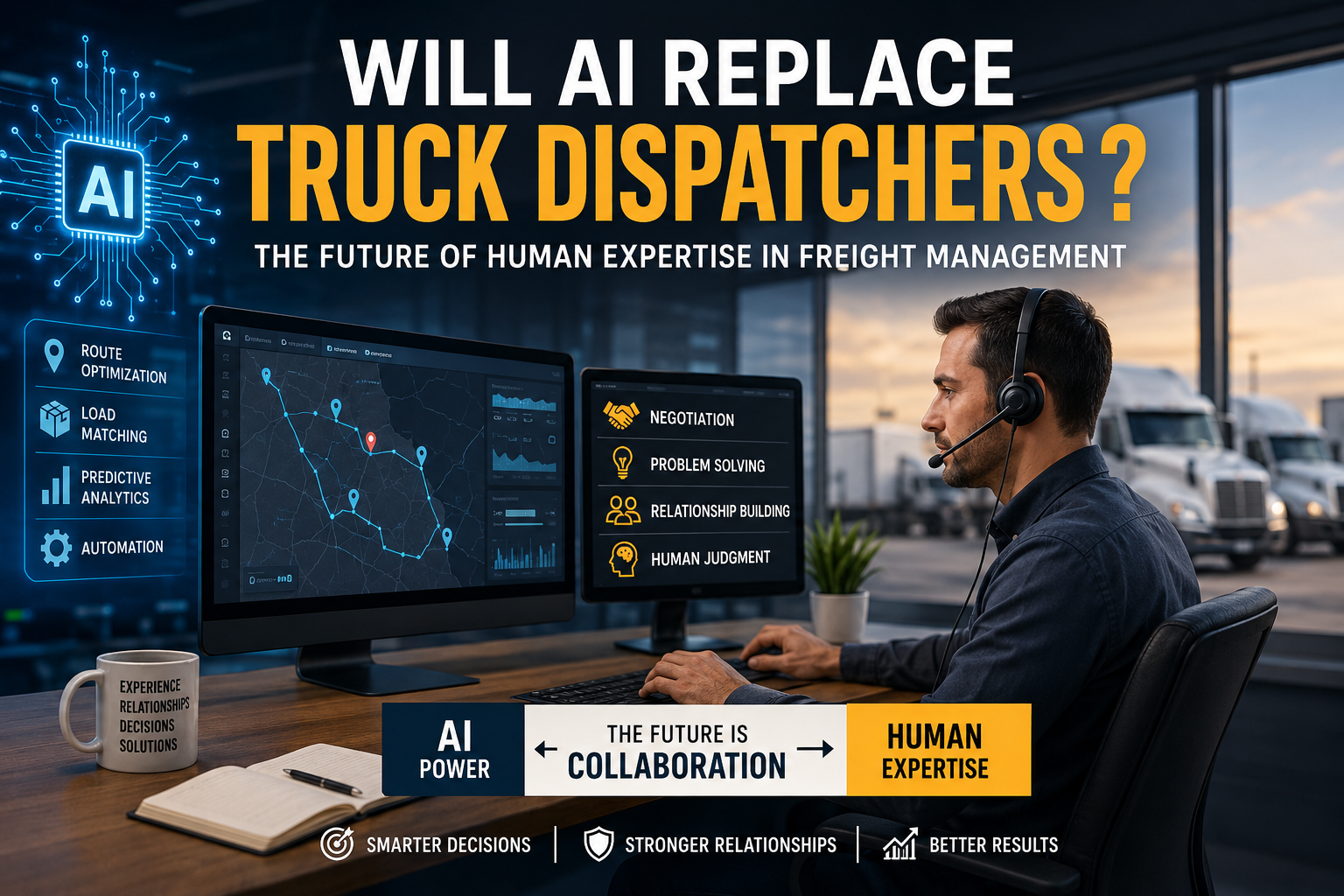
Will AI Replace Truck Dispatchers? The Future of Human Expertise in Freight Management
Artificial Intelligence is transforming industries at an unprecedented pace. From customer service and manufacturing to healthcare and finance, AI-powered tools are changing how businesses operate, make decisions, and improve efficiency. The trucking industry is no exception.
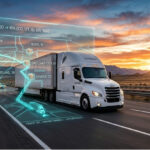
In recent years, AI-driven technologies have entered nearly every aspect of freight transportation. Route optimization software can calculate the most efficient paths in seconds. Load-matching platforms can connect carriers with freight opportunities automatically. Predictive analytics tools can forecast market trends and identify potential disruptions before they occur.
As these technologies become more advanced, a common question continues to emerge:
Will AI replace truck dispatchers?
For owner-operators, fleet owners, and logistics professionals, the answer is important because dispatching remains one of the most critical functions in freight management. While AI is undoubtedly changing how dispatching works, the future is more nuanced than a simple replacement of humans by machines.
The reality is that AI is transforming dispatching, but human expertise remains essential in ways technology cannot fully replicate.
Why AI Is Gaining Attention in Truck Dispatching
The trucking industry generates enormous amounts of data every day.
Dispatchers must consider:
- Freight availability
- Market conditions
- Driver schedules
- Traffic patterns
- Fuel costs
- Delivery deadlines
- Equipment availability
Traditionally, managing this information required significant manual effort. AI systems now have the ability to process vast amounts of data within seconds, providing recommendations that would take humans much longer to develop.
This capability has made AI an attractive tool for carriers looking to improve efficiency and reduce administrative workloads.
As a result, many logistics companies are investing heavily in AI-powered dispatching platforms and transportation management systems.
What AI Does Well
Artificial Intelligence excels at analyzing data and identifying patterns.
In dispatching, AI can assist with several operational tasks.
Route Optimization
Modern AI systems can analyze traffic conditions, weather forecasts, road restrictions, and fuel consumption data to identify efficient routes.
This helps reduce delays, improve fuel efficiency, and increase on-time deliveries.
Load Matching
AI-powered freight platforms can automatically connect available trucks with suitable loads based on equipment type, location, and delivery requirements.
This process reduces the time spent manually searching for freight opportunities.
Market Analysis
AI can evaluate historical and real-time freight data to identify market trends and rate fluctuations.
This allows carriers to make more informed decisions about where to position equipment and which lanes may offer stronger opportunities.
Administrative Automation
Many repetitive tasks can now be automated through AI, including:
- Appointment scheduling
- Status updates
- Data entry
- Freight tracking
- Document processing
These capabilities help dispatchers focus on higher-value responsibilities instead of routine administrative work.
The Tasks AI Cannot Easily Replace
While AI is highly effective at processing information, dispatching involves much more than data analysis.
Many of the most valuable aspects of dispatching rely on human judgment, experience, communication, and relationship-building.
These areas remain difficult for technology to replicate.
Building Broker Relationships
One of the most overlooked aspects of dispatching is relationship management.
Experienced dispatchers spend years developing trust with brokers, shippers, and carriers.
Strong relationships often lead to:
- Better freight opportunities
- Faster load confirmations
- Higher negotiated rates
- Consistent freight availability
AI can analyze data, but it cannot build genuine trust or professional relationships in the same way humans can.
Negotiating Rates
Successful dispatching often requires negotiation.
Every load presents unique circumstances, including:
- Market conditions
- Freight urgency
- Lane demand
- Equipment availability
Experienced dispatchers understand when to push for higher rates, when to walk away from a load, and when market conditions justify flexibility.
While AI can recommend pricing strategies, negotiation remains a fundamentally human skill.
Managing Unexpected Situations
The trucking industry rarely operates exactly as planned.
Unexpected challenges can arise at any time, including:
- Equipment breakdowns
- Weather disruptions
- Traffic incidents
- Driver emergencies
- Appointment changes
- Customer requests
In these situations, dispatchers must make quick decisions while balancing operational priorities and customer expectations.
Human judgment plays a critical role when circumstances become unpredictable.
Understanding Human Factors
Dispatchers do not only manage trucks.
They manage people.
Drivers have preferences, concerns, and individual working styles that influence operational decisions.
A skilled dispatcher understands:
- Driver strengths
- Communication styles
- Scheduling preferences
- Fatigue concerns
- Personal circumstances
These human factors are difficult to measure through algorithms alone.
The Real Future: AI-Assisted Dispatching
The discussion should not be framed as AI versus human dispatchers.
A more realistic question is:
How will AI help dispatchers become more effective?
The future of freight management is likely to involve collaboration between technology and human expertise.
AI will continue handling:
- Data analysis
- Route optimization
- Administrative tasks
- Freight forecasting
- Load recommendations
Meanwhile, human dispatchers will focus on:
- Strategic planning
- Relationship management
- Negotiation
- Problem-solving
- Customer communication
This combination allows businesses to benefit from both technological efficiency and human experience.
Why Human Expertise Still Creates Competitive Advantages
In a competitive freight market, small decisions can have significant financial consequences.
Choosing the wrong lane, accepting an unprofitable load, or failing to build strong broker relationships can affect revenue and operational performance.
Experienced dispatchers bring context to decision-making.
They understand nuances that may not appear in historical data or predictive models.
For example, a dispatcher may know:
- Which brokers consistently offer reliable freight
- Which lanes create better reload opportunities
- Which customers frequently adjust schedules
- Which markets are becoming stronger before data fully reflects the trend
These insights often come from experience rather than algorithms.
This is where human expertise continues to provide value.
How AI Is Changing the Role of Dispatchers
Rather than replacing dispatchers, AI is changing their responsibilities.
Future dispatchers are likely to spend less time on repetitive administrative work and more time on strategic decision-making.
Their role will increasingly involve:
- Managing customer relationships
- Overseeing operations
- Interpreting AI recommendations
- Solving complex challenges
- Supporting business growth
In many ways, AI may elevate the role of dispatchers by allowing them to focus on activities that create greater value.
What This Means for Owner-Operators and Fleet Owners
For owner-operators and fleet owners, AI should be viewed as a tool rather than a threat.
Technology can improve efficiency, reduce administrative burdens, and provide valuable operational insights.
However, relying solely on automation may limit opportunities that require human expertise.
The most successful trucking businesses will likely combine advanced technology with experienced dispatch support.
This balanced approach offers the benefits of automation while preserving the flexibility, judgment, and relationship-building capabilities that remain essential in freight management.
How Truckings Pro Combines Technology and Human Expertise
At Truckings Pro, we recognize the growing role of technology in modern freight management.
We use advanced tools and market insights to improve load planning, route optimization, and operational efficiency.
At the same time, we understand that successful dispatching depends on more than algorithms.
Our team focuses on:
- Building broker relationships
- Negotiating competitive rates
- Coordinating freight efficiently
- Solving operational challenges
- Supporting owner-operators and fleet owners
By combining technology with experienced human dispatchers, we help carriers navigate an increasingly complex trucking landscape.
Final Thoughts
Artificial Intelligence is reshaping the trucking industry and changing how freight operations are managed. Its ability to process data, automate tasks, and improve efficiency makes it a valuable tool for modern dispatching.
However, dispatching is not simply a data-driven process. It involves negotiation, relationship-building, communication, judgment, and problem-solving, areas where human expertise continues to play a critical role.
Rather than replacing truck dispatchers, AI is likely to become a powerful partner that enhances their capabilities.
The future of freight management is not about choosing between humans and technology. It is about combining the strengths of both to create smarter, more efficient, and more profitable trucking operations.