
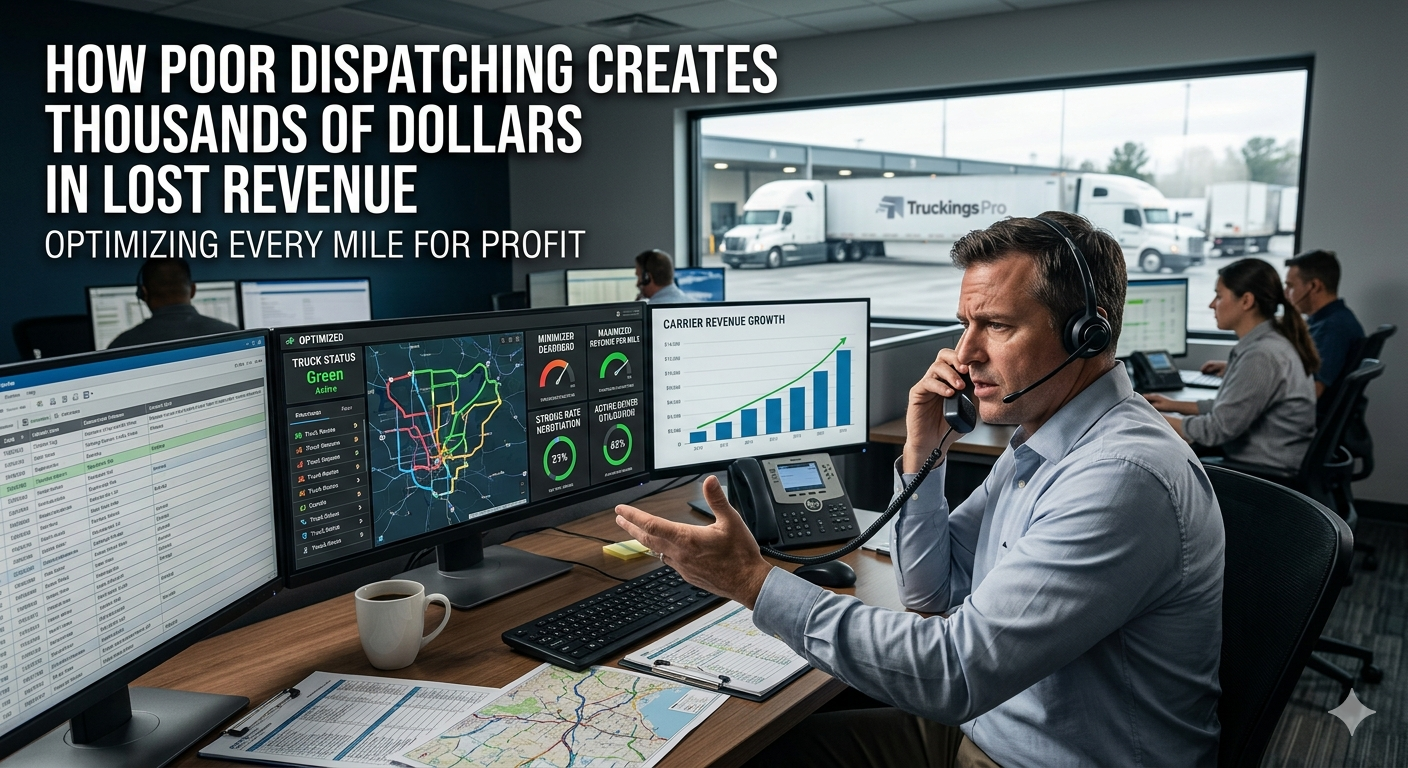
How Poor Dispatching Creates Thousands of Dollars in Lost Revenue
Most trucking companies focus heavily on fuel costs, maintenance expenses, insurance premiums, and freight rates when evaluating profitability. While these costs certainly impact the bottom line, many carriers overlook one of the biggest profit drivers in their business: dispatching.
Dispatching is often viewed as an administrative function responsible for finding loads and communicating with brokers. In reality, dispatching plays a critical role in determining how efficiently a trucking operation runs and how much revenue it generates.
When dispatching is done effectively, trucks stay loaded, routes are optimized, downtime is minimized, and profitability improves. When dispatching is poorly managed, revenue begins to leak from multiple areas of the business, often without owners realizing how much money is being lost.
For owner-operators and fleet owners, poor dispatching can quietly cost tens of thousands of dollars each year.
Let’s examine where those losses occur and why effective dispatching is one of the most important investments a trucking business can make.
Dispatching Is More Than Just Finding Loads
Many trucking businesses assume that a dispatcher’s primary responsibility is simply locating freight.
In reality, dispatching influences nearly every aspect of operational performance, including:
- Load selection
- Rate negotiation
- Route planning
- Driver utilization
- Deadhead reduction
- Scheduling efficiency
- Broker relationships
- Revenue per mile
A dispatcher’s decisions directly affect how profitable each truck becomes.
Poor decisions made repeatedly over weeks and months can create substantial financial losses.
Excessive Deadhead Miles: Paying to Drive Empty
One of the most common signs of poor dispatching is excessive deadhead mileage.
Deadhead miles occur when a truck travels without a paying load. While some empty miles are unavoidable, inefficient load planning can dramatically increase non-revenue-producing miles.
Industry averages often place deadhead rates between 10% and 20%, but poorly managed operations can exceed 25%.
Consider a truck running 10,000 miles per month.
If 15% of those miles are deadhead:
- Empty miles: 1,500
- Average operating cost: $1.75–$2.25 per mile
Monthly deadhead cost:
- $2,625–$3,375
Annual deadhead cost:
- $31,500–$40,500
These costs generate zero revenue while still consuming fuel, maintenance resources, tires, and driver time.
Strong dispatching focuses on minimizing empty miles through strategic load planning and freight positioning.
Accepting Low-Paying Loads Reduces Profitability
A truck can be busy every day and still fail to produce healthy profits.
Poor dispatching often results in accepting freight based on availability rather than profitability.
This creates situations where trucks:
- Travel long distances for low rates
- Enter weak freight markets
- Face limited reload opportunities
- Generate lower revenue per mile
For example:
Load A
- 1,000 miles
- $2.60 per mile
- Revenue: $2,600
Load B
- 1,000 miles
- $2.00 per mile
- Revenue: $2,000
Difference:
- $600 per load
Assuming only eight similar loads per month, poor load selection could cost:
- $4,800 monthly
- $57,600 annually
Effective dispatchers focus on maximizing profitability rather than simply keeping trucks occupied.
Downtime Between Loads Creates Revenue Gaps
Every hour a truck sits idle represents lost earning potential.
Poor dispatching often leads to:
- Delays between deliveries and reloads
- Last-minute load searches
- Scheduling conflicts
- Missed freight opportunities
If a truck typically generates between $800 and $1,200 per day, just four idle days per month could result in:
- $3,200–$4,800 in lost monthly revenue
- $38,400–$57,600 annually
Many trucking businesses focus on reducing expenses while ignoring the substantial cost of underutilized equipment.
A truck parked at a truck stop earns nothing while expenses continue accumulating.
Weak Rate Negotiation Leaves Money on the Table
Rate negotiation is one of the most overlooked aspects of dispatching.
Many dispatchers simply accept posted rates without exploring opportunities for improvement.
However, even small increases in freight rates can have a significant impact on annual revenue.
Consider a truck hauling 10,000 loaded miles per month.
Improving rates by just:
- $0.15 per mile
Results in:
- $1,500 additional monthly revenue
- $18,000 additional annual revenue
A skilled dispatcher understands market conditions, lane demand, and broker relationships, allowing them to negotiate more effectively.
Poor Route Planning Increases Operating Costs
Route planning affects much more than travel distance.
Poorly planned routes often result in:
- Increased fuel consumption
- Traffic delays
- Excessive toll expenses
- Missed appointments
- Additional driver hours
Imagine a truck driving just 50 unnecessary miles per day because of inefficient routing.
Over a month:
- 1,000 additional miles
At an average operating cost of $2.00 per mile:
- $2,000 monthly
- $24,000 annually
Dispatching decisions made before a truck leaves the yard can have a major impact on operating costs.
Poor Market Positioning Limits Revenue Opportunities
Successful dispatching requires understanding freight markets.
Some dispatchers focus only on securing the next available load rather than strategically positioning trucks in strong freight regions.
As a result, carriers often find themselves operating in markets with:
- Lower rates
- Limited freight availability
- Increased competition
Strong dispatching involves planning several loads ahead rather than focusing solely on immediate opportunities.
Proper positioning can significantly improve revenue per mile and reduce deadhead.
Administrative Inefficiencies Slow Operations
Poor dispatching often creates operational bottlenecks.
These may include:
- Delayed paperwork
- Missed appointments
- Communication breakdowns
- Incomplete broker packets
- Slow load confirmations
Administrative delays frequently lead to:
- Lost loads
- Longer downtime
- Reduced productivity
- Customer dissatisfaction
While these issues may seem minor individually, their cumulative impact can be substantial.
Broker Relationships Matter More Than Many Realize
Many dispatchers rely entirely on public load boards.
However, some of the best freight opportunities never make it to public listings.
Experienced dispatchers build strong relationships with brokers, creating access to:
- Premium freight
- Better-paying lanes
- Consistent load opportunities
- Faster load assignments
Without these relationships, carriers often compete for lower-paying freight alongside hundreds of other trucks.
The Financial Impact of Poor Dispatching
When these inefficiencies combine, the losses become significant.
|
Revenue Leak |
Potential Annual Impact |
|
Deadhead Miles |
$31,500–$40,500 |
|
Driver Downtime |
$38,400–$57,600 |
|
Poor Load Selection |
$57,600+ |
|
Weak Rate Negotiation |
$18,000+ |
| Route Inefficiencies |
$24,000+ |
For many carriers, poor dispatching can easily cost $100,000 to $150,000 or more annually.
The issue isn’t usually one major mistake.
It’s a series of small inefficiencies repeated every day.
What Effective Dispatching Looks Like
Professional dispatching focuses on maximizing profitability across every stage of the operation.
Key priorities include:
- Securing high-paying freight
- Reducing deadhead miles
- Optimizing routes
- Negotiating stronger rates
- Minimizing downtime
- Building broker relationships
- Improving truck utilization
The goal isn’t simply to keep trucks moving.
The goal is to ensure every mile contributes to profitability.
How Truckings Pro Helps Carriers Maximize Revenue
At Truckings Pro, we understand that dispatching directly impacts a carrier’s bottom line.
Our dispatch professionals help owner-operators and fleet owners:
- Find profitable freight opportunities
- Reduce empty miles
- Improve route efficiency
- Negotiate competitive rates
- Minimize downtime
- Increase revenue per mile
By focusing on both revenue generation and operational efficiency, we help carriers unlock the full earning potential of their equipment.
Final Thoughts
Many trucking businesses assume declining profits are caused by rising fuel prices or market conditions alone. While these factors certainly play a role, poor dispatching often has a far greater impact than most carriers realize.
Excessive deadhead miles, weak rate negotiations, downtime, inefficient routing, and poor load planning quietly drain revenue every day.
The most successful trucking companies understand that dispatching is not simply an administrative function; it’s a profit-driving function.
When managed correctly, dispatching can transform operational efficiency, increase revenue, and create a significant competitive advantage in today’s trucking market.