
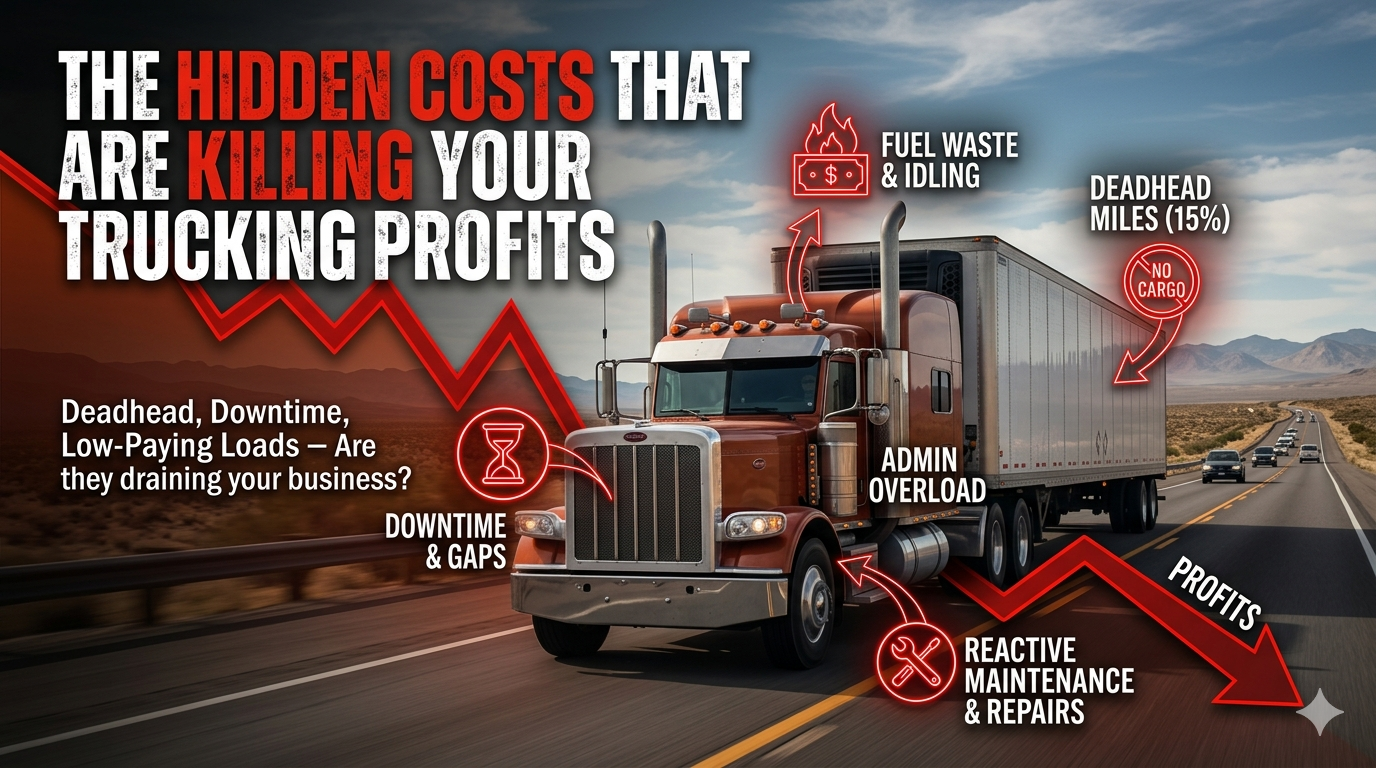
The Hidden Costs That Are Killing Your Trucking Profits
Most trucking businesses closely monitor visible expenses such as fuel, insurance, maintenance, and truck payments. Yet many owner-operators and fleet owners still struggle to understand why their profit margins remain tight despite keeping their trucks on the road.
The answer often lies in costs that rarely appear on a profit-and-loss statement. These hidden operational expenses quietly drain revenue every day through inefficient routing, deadhead miles, downtime, poor load planning, and administrative burdens.
Individually, these costs may seem insignificant. Collectively, they can cost a trucking business tens of thousands of dollars each year.
Let’s take a closer look at the profit leaks that could be hurting your bottom line.
Deadhead Miles: The Silent Profit Killer
Deadhead miles are one of the most expensive yet overlooked costs in trucking.
Industry estimates suggest that many carriers operate with 10% to 20% deadhead miles, while poorly optimized operations can exceed 25%.
Consider a truck running approximately 10,000 miles per month.
If 15% of those miles are deadhead, that’s 1,500 miles generating zero revenue.
With average operating costs ranging between $1.75 and $2.25 per mile, those empty miles can cost anywhere from:
- $2,625 to $3,375 per month
- $31,500 to $40,500 per year
That’s money being spent on fuel, maintenance, tires, and depreciation without producing any income.
Reducing deadhead by even 5% can significantly improve profitability without increasing workload.
Poor Load Selection Can Cost Thousands
Many carriers make the mistake of focusing on keeping the truck moving rather than maximizing revenue per mile.
A busy truck isn’t always a profitable truck.
Consider these two freight opportunities:
- Load A: $2,200 for 1,000 miles
- Load B: $2,600 for 1,000 miles
The difference is only $400 on a single trip.
However, if a carrier secures similar higher-paying loads throughout the month, that difference can exceed:
- $4,000 additional monthly revenue
- Nearly $50,000 additional annual revenue
The highest-performing carriers evaluate freight opportunities based on profitability, reload potential, lane demand, and overall efficiency, not just availability.
Driver Downtime Is More Expensive Than Most Realize
Every hour a truck sits idle represents lost earning potential.
Downtime often occurs because of:
- Gaps between loads
- Poor dispatch planning
- Delayed appointments
- Limited freight availability
- Scheduling conflicts
If a truck typically generates between $800 and $1,200 per day, just four idle days per month could result in:
- $3,200 to $4,800 in lost monthly revenue
- $38,400 to $57,600 in lost annual revenue
Many carriers focus on reducing expenses while overlooking the financial impact of unused equipment and lost opportunities.
Fuel Waste Goes Beyond Diesel Prices
Fuel is often one of the largest operational expenses in trucking, accounting for approximately 20% to 30% of total operating costs.
A truck consuming around 1,600 gallons of diesel per month may spend between:
- $6,000 and $8,000 monthly on fuel
- $72,000 to $96,000 annually
However, rising fuel prices aren’t always the primary problem.
Much of the waste comes from operational inefficiencies such as:
- Excessive idling
- Traffic congestion
- Poor route planning
- Unnecessary detours
- Poor load coordination
Improving fuel efficiency by just 5% could save:
- $300 to $400 per month per truck
- $3,600 to $4,800 annually per truck
For fleets operating multiple trucks, those savings multiply quickly.
Administrative Tasks Are Stealing Revenue-Generating Time
Many owner-operators underestimate the true cost of administrative work.
Tasks such as:
- Searching load boards
- Negotiating rates
- Completing paperwork
- Scheduling appointments
- Communicating with brokers
- Tracking shipments
can easily consume 10 to 20 hours per week.
That’s valuable time that could be spent driving and generating revenue.
For drivers capable of producing $80 to $120 in revenue per productive hour, administrative responsibilities can represent thousands of dollars in unrealized earning potential every month.
The issue isn’t the paperwork itself; it’s the opportunity cost associated with handling everything alone.
Reactive Maintenance Leads to Expensive Breakdowns
Many trucking businesses delay maintenance to reduce short-term expenses.
Unfortunately, this often creates larger financial problems later.
A typical preventive maintenance service may cost:
- $300 to $800
By comparison, a roadside breakdown can easily result in:
- $2,000 to $10,000+ in repairs
- Towing expenses
- Delivery delays
- Customer dissatisfaction
- Lost revenue during downtime
The most profitable fleets view maintenance as an investment rather than an expense.
Preventive maintenance helps avoid disruptions that can quickly erase profits from multiple loads.
Weak Broker Relationships Reduce Earning Potential
Many carriers focus solely on securing freight rather than building long-term broker relationships.
This approach often leads to:
- Lower-paying loads
- Increased competition
- Reduced consistency
- Limited access to premium freight
Experienced dispatchers and established carriers often gain access to preferred loads before they ever reach public load boards.
Over time, strong broker relationships can have a significant impact on both revenue and business stability.
The Cost of Managing Everything Yourself
Many owner-operators attempt to handle dispatching, load sourcing, negotiations, route planning, paperwork, and customer communication on their own.
While this may appear to save money, it often creates hidden costs such as:
- Missed load opportunities
- Increased downtime
- Lower negotiated rates
- More deadhead miles
- Administrative overload
The true cost isn’t what you’re spending, it’s what you’re losing.
Every hour spent managing logistics is an hour that could be spent moving freight and generating revenue.
What Are These Hidden Costs Really Worth?
When combined, these operational inefficiencies can have a significant impact on annual profitability.
| Hidden Cost | Potential Annual Impact |
| Deadhead Miles | $31,500 – $40,500 |
| Driver Downtime | $38,400 – $57,600 |
| Poor Load Selection | Up to $50,000+ |
| Fuel Inefficiencies | $3,600 – $4,800 |
| Emergency Repairs | $5,000 – $15,000+ |
For many carriers, hidden operational costs can easily exceed $75,000 to $100,000 annually.
The challenge isn’t always generating more revenue. Often, it’s preventing existing revenue from slipping through the cracks.
How Truckings Pro Helps Protect Your Profit Margins
At Truckings Pro, we understand that profitability depends on more than simply booking loads.
Our dispatch professionals help carriers:
- Reduce deadhead miles
- Secure higher-paying freight
- Improve route efficiency
- Minimize downtime
- Optimize scheduling
- Increase revenue per mile
By focusing on operational efficiency and strategic load planning, we help owner-operators and fleet owners maximize earnings while reducing unnecessary expenses.
Final Thoughts
Many trucking businesses assume their biggest threats to profitability are fuel prices or maintenance costs. In reality, the most damaging expenses are often the ones hidden within daily operations.
Deadhead miles, downtime, inefficient dispatching, poor load selection, and administrative burdens quietly erode profits month after month.
The carriers that consistently outperform their competitors are those that identify these hidden costs early and take proactive steps to eliminate them.
In today’s trucking industry, protecting profit margins isn’t just about hauling more freight; it’s about operating smarter.